Bitcoin ETF attracts US$10 billion every quarter, is the market supply of chips exceeding demand?
As spot Bitcoin ETF funds continue to inflow, institutional demand for Bitcoin is accelerating, creating a supply shortage and strengthening its long-term bullish structure.
(Preliminary summary: Bitcoin ETF capital inflows slow down, whether BTC can recover US$114,000 is the key)
(Background supplement: Ethereum spot ETF has net inflows for 15 consecutive days; in contrast, Bitcoin ETF outflows exceeded US$1 billion during the same period)
With spot Bitcoin ETFs injecting 5 billion to 100 billion into the market every quarter With billions of dollars in funding, institutional demand for Bitcoin is accelerating.
This new wave of funding is tightening Bitcoin’s supply and reinforcing its long-term bullish structure.
Bitwise Chief Technology Officer Hong Kim cited data from Farside Investors and said that ETF capital inflows have formed a stabilizing force "as precise as a clock", describing it as a "long-term trend that cannot be stopped even in a four-year cycle" and predicting that "it will rise again in 2026."
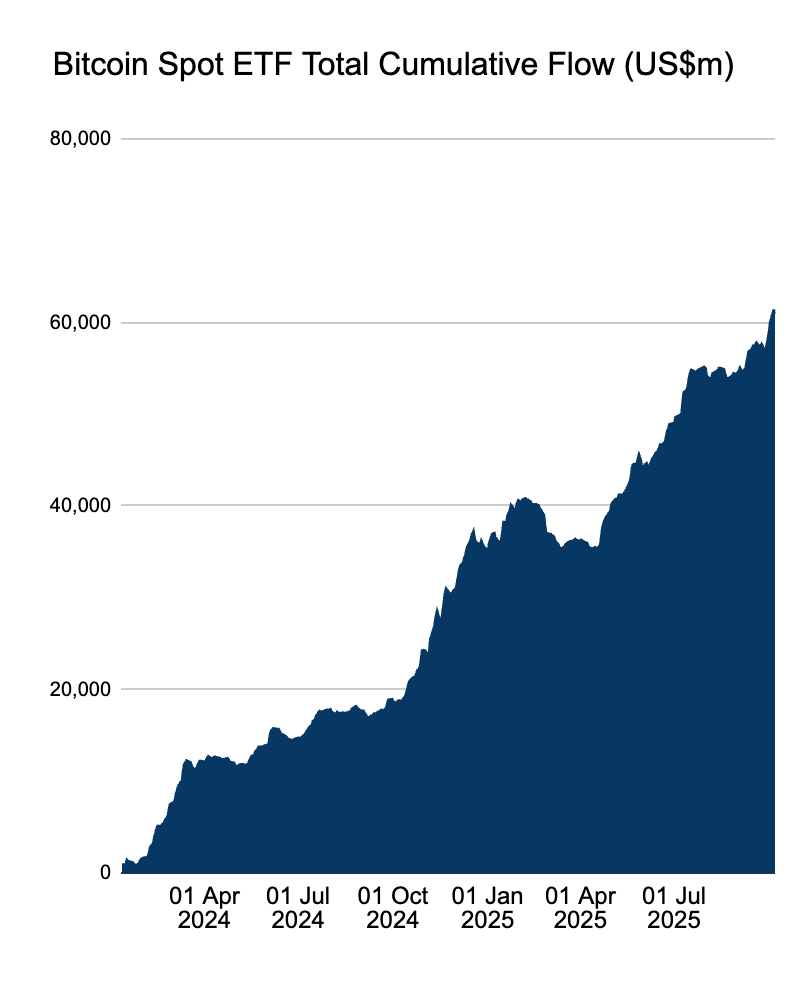
The continued inflow of funds reflects the deep changes in the way traditional finance interacts with Bitcoin. Once dismissed as a speculative commodity, the flagship cryptocurrency is now being channeled through regulated investment vehicles, bringing predictable and sustained liquidity.
The managed assets of global crypto funds (including Bitcoin and Ethereum-themed products) have exceeded US$250 billion, showing that institutions are incorporating digital assets into diversified investment portfolios.
The steady inflow of institutional capital not only pushes up the price, but also reshapes the supply pattern of Bitcoin.
Bitwise European Research Director Andre Dragosh disclosed that institutions have purchased a total of 944,330 Bitcoins in 2025, exceeding the 913,006 Bitcoins in the whole of last year.
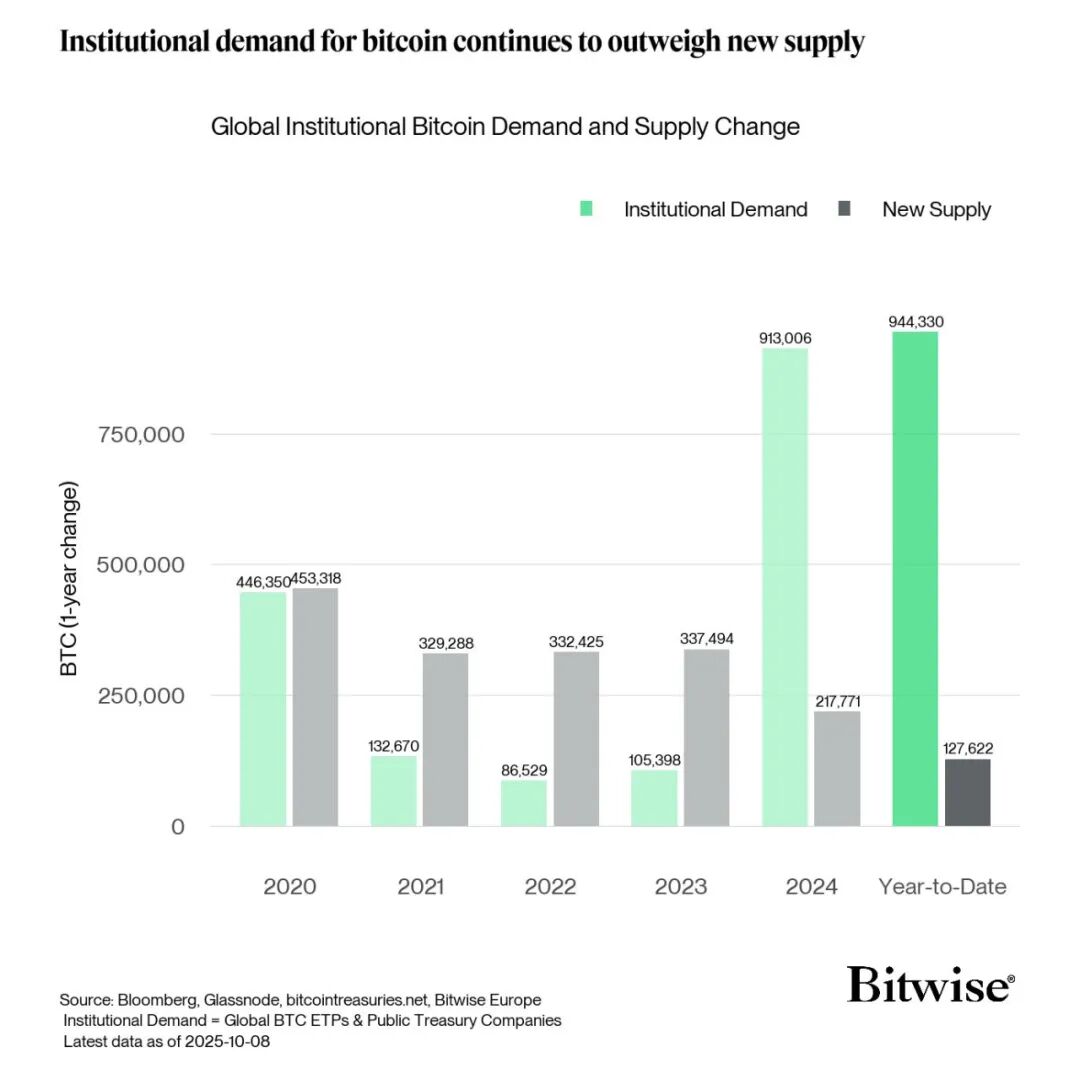
In comparison, miners have only produced 127,622 new coins this year, and institutional purchases are 7.4 times the supply of new coins.
This imbalance stems from the 2024 SEC final approval of a spot Bitcoin ETF.
The approval triggered a structural shift: demand for regulated funds suddenly exceeded supply, reversing the slump in institutional participation caused by policy uncertainty between 2020 and 2023.
BlackRock’s entry into the iShares Bitcoin Trust was symbolic, prompting other giants to follow suit.
This trend will continue into 2025 as U.S. policy signals get warmer and Bitcoin’s recognition as a treasury reserve asset increases. Some companies with government backgrounds have begun to include Bitcoin directly on their balance sheets, highlighting their increasing institutional credibility.
With nearly three months left in the year and no sign of a slowdown in capital inflows, analysts expect the Bitcoin supply shortage to intensify.
The gap between issuance and demand shows that ETF-driven asset accumulation has changed market fundamentals, causing Bitcoin to gradually lose its speculative attributes and transform into a global financial instrument with sustained institutional demand.