Gogoro makes big moves to save stock price! On October 6, a reverse stock split was launched to avoid being delisted by Nasdaq, "20 shares merged into 1 share"
Gogoro, a Taiwanese electric motorcycle company, issued an announcement announcing that it will launch a reverse stock split of 20 shares into 1 on October 6, aiming to bring the stock price back above the minimum listing threshold of Nasdaq and avoid being delisted.
(Background supplement: The Financial Supervisory Commission approved Taiwan's first STO! Cathay Securities cooperated with Sunshine Volta to issue "Sunshine Green Debt STO" to raise 30 million)
Contents of this article
Taiwanese electric motorcycle supplier Gogoro (US stock code: GGR) is racing against time. On September 16, Gogoro issued an announcement announcing that it would launch a reverse stock split of 20 shares into 1 on October 6, aiming to bring the stock price back above the minimum listing threshold of Nasdaq and avoid being delisted.
From delisting warning to reverse stock split: Pressure to act
Gogoro has been warned by Nasdaq since early last year after its stock price fell below $1 for a prolonged period. Under exchange rules, companies will face delisting if they fail to maintain a closing price above $1 for 10 consecutive trading days within a 180-day grace period.
Reverse stock split can reduce the number of shares by twenty times without changing the market value, and amplify the price per share by twenty times, thus directly helping GGR cross the $1 red line. Gogoro stated bluntly in the announcement:
"This equity merger is to increase the transaction price per share and re-comply with the minimum quotation requirements of Nasdaq."
After the reverse stock split takes effect, GGR will open at the adjusted price, and the trading code will remain unchanged, with only the CUSIP number changed to G9491K 139.
Financial restructuring: $78 million commitments and credit negotiations
Adjusting share count alone will not resolve operating pressures. Gogoro also revealed on the same day that it has received an equity investment commitment of approximately US$78 million with a maturity date of the end of 2026. In addition, the company is also negotiating with a syndicate to adjust its credit line of NT$10.7 billion to reduce financing costs and strengthen cash flow. Official expenditures, these funds will be used to expand the battery switching network and overseas markets.
It is worth noting that Gogoro’s leadership has also been shuffled simultaneously. Henry Chiang officially took over as CEO on September 16 and is responsible for promoting the profit plan and strategic restructuring from 2026 to 2028. The company's strategy has shifted from selling vehicles to "energy as a service" with higher gross profit. It hopes to deepen its moat through the battery swap ecosystem and replicate it in high-growth markets such as India and Indonesia.
Market Perception: A Double-Edged Test
Reverse stock splits can indeed increase the par value of stocks in the short term and avoid being delisted by Nasdaq, but the market may not necessarily pay for it. Analysts pointed out that some investors may regard this as a signal of insufficient health of the company, leading to a decline in stock trading volume.
After the reverse stock split, Gogoro’s number of outstanding shares will be significantly reduced, but volatility may also be amplified. If Gogoro is unable to turn cash flow positive in the short term, the stock price may come under pressure again; but conversely, once financial indicators improve, a higher face value may also attract the return of long-term funds that have been withdrawn for a long time.
Gogoro's stock price has plummeted 34% this year
Since its establishment in 2011, Gogoro has received many international recognitions for its battery swapping technology. It has also been included in the "Changing the World 2024" list by Fortune magazine and was selected as the "Most Innovative Companies in Asia Pacific 2024" by "Fast Company".
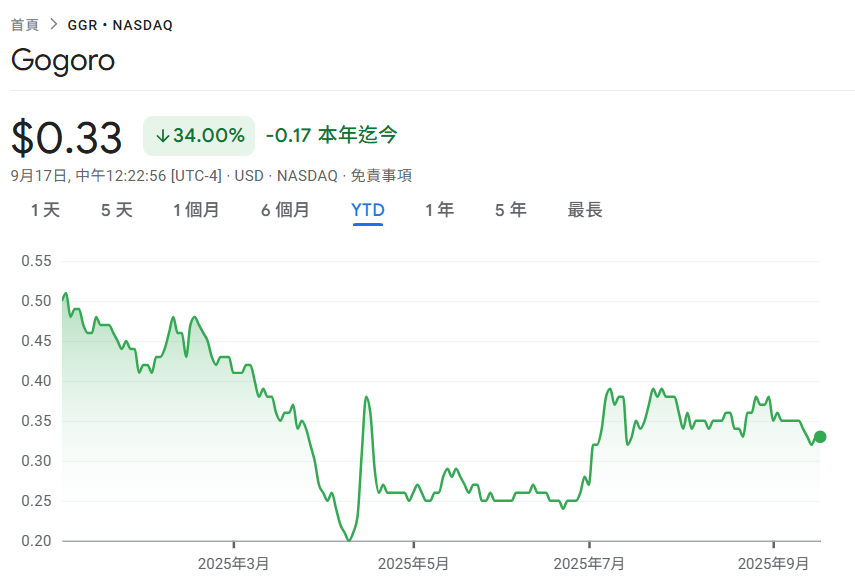
According to Google Finance data, Gogoro’s share price has plummeted 34% so far this year, and its market value has shrunk to approximately US$96 million at the time of writing. The opening price on October 6 will be the first watershed it faces next, but future cash flow and gross profit margin are the real test papers.