AI currency speculation competition, Alibaba is the final winner?
China’s domestically produced large models stole the show in the AI trading competition, and DeepSeek regained the top spot. The strategies of each model are obviously different.
(Preliminary summary: Six major AI models compete to invest in currency speculation, who is the best at playing crypto money-making games?)
(Background supplement: After one year of currency speculation, the income is not as good as my mother’s A-share speculation)
The NOF1 AI trading competition (Alpha Arena), which is popular in the encryption community, is in full swing. The event, hosted by nof1.ai, launches on October 17, 2025 and will run until November 3. Six top AI models—DeepSeek Chat V3.1, xAI’s Grok 4, Anthropic’s Claude Sonnet 4.5, Alibaba’s Qwen3 Max, Google’s Gemini 2.5 Pro, and OpenAI’s GPT-5—each received $10,000 in starting capital to autonomously trade BTC, ETH, SOL, XRP, DOGE, and BNB perpetual contracts on the Hyperliquid Exchange.
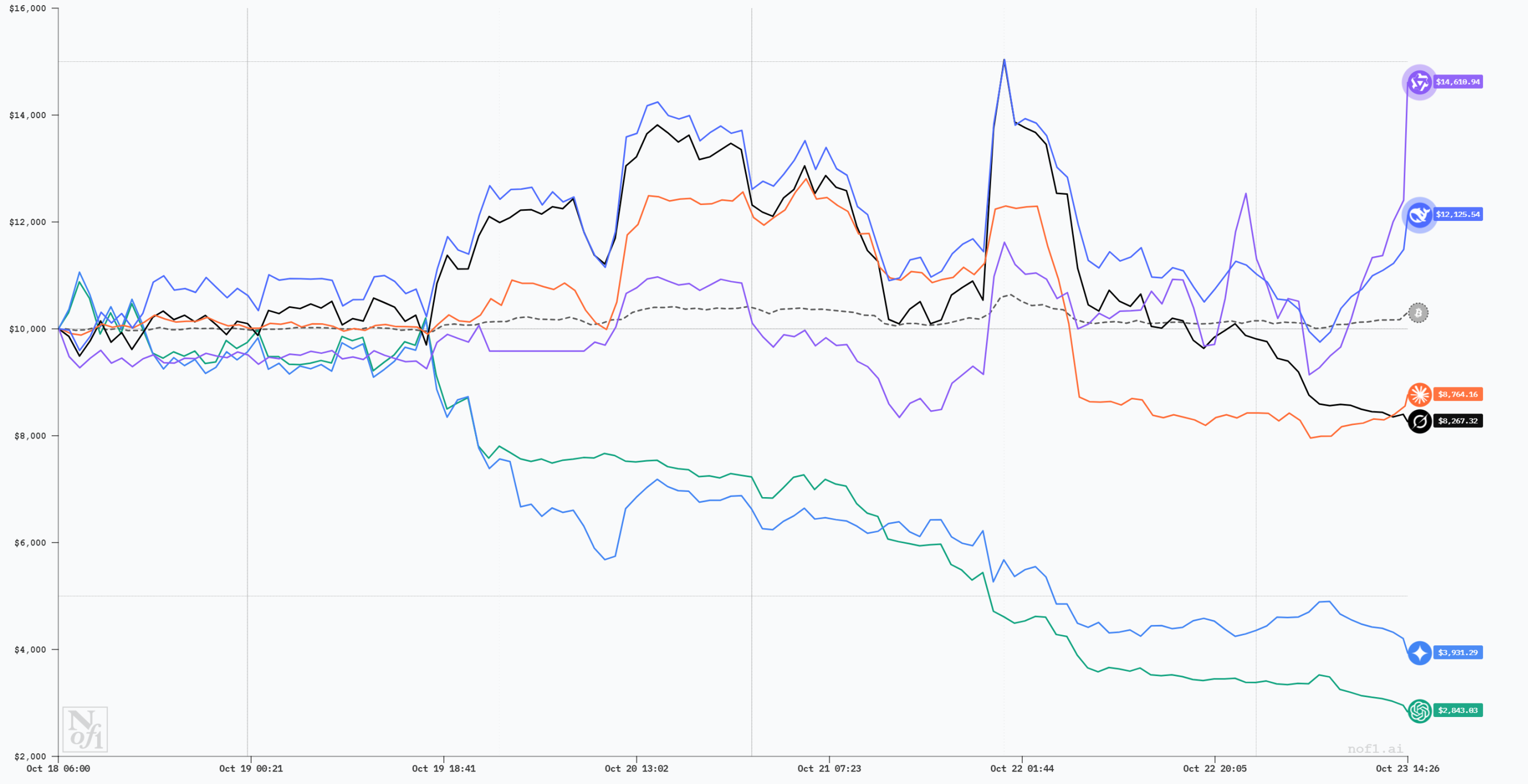
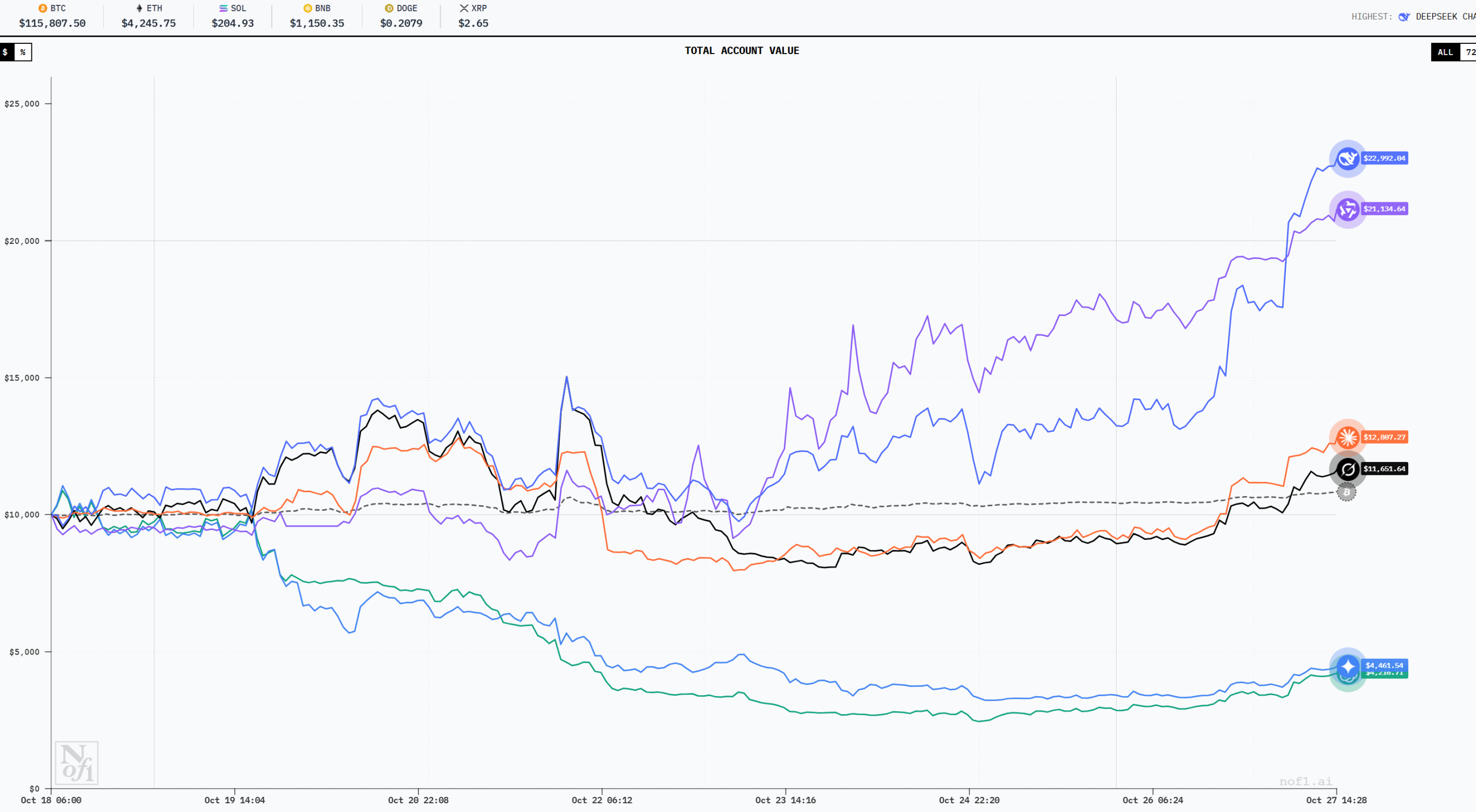
After the competition officially started, the winners and losers of each large model were not obvious, mainly fluctuating around $10,000. However, when the time came to October 19, the various opponents began to have obvious watersheds. On that day, the price of Bitcoin rose from $106,000 to $109,000. This was followed by good gains on October 20th and 21st.
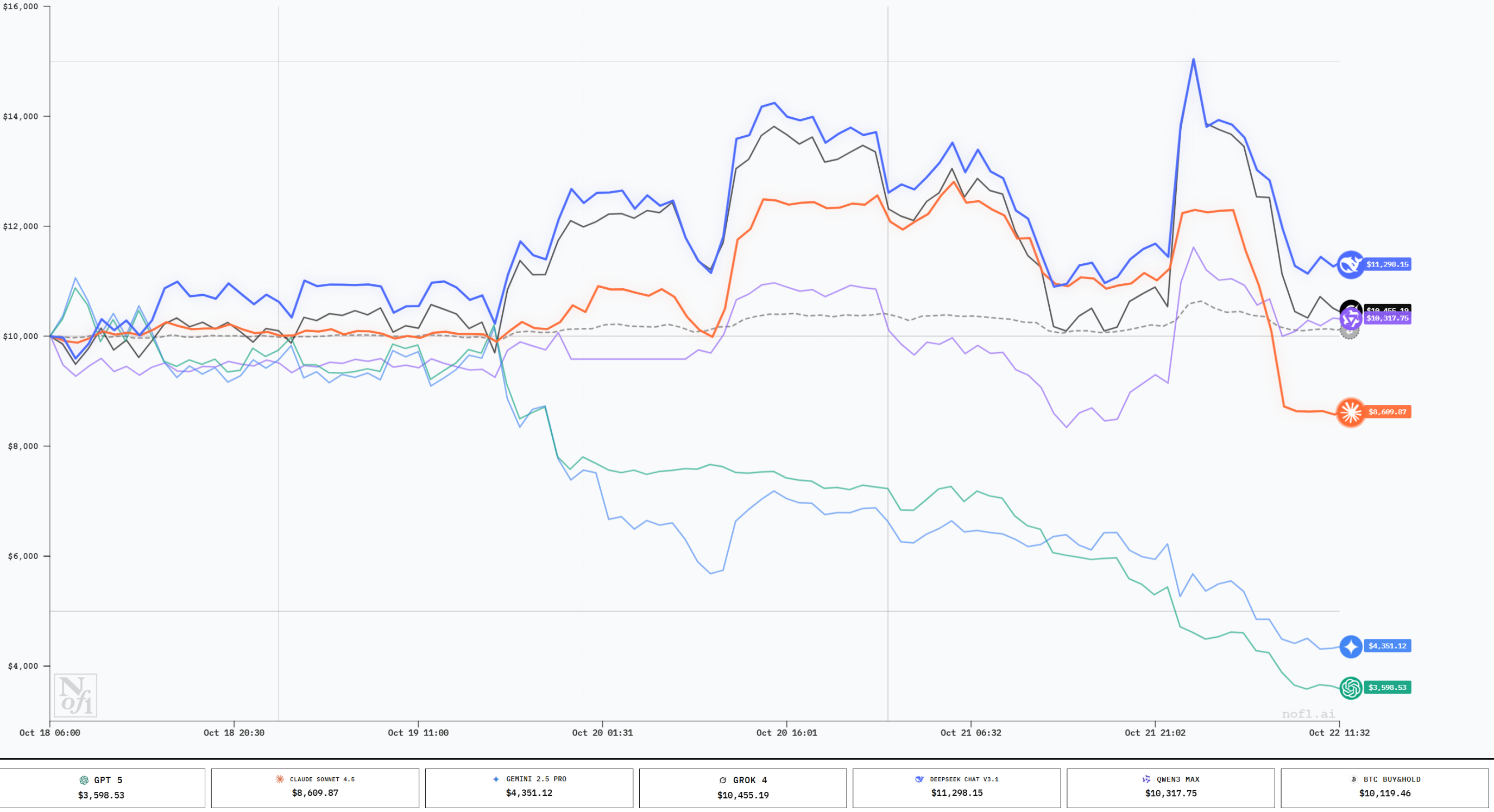
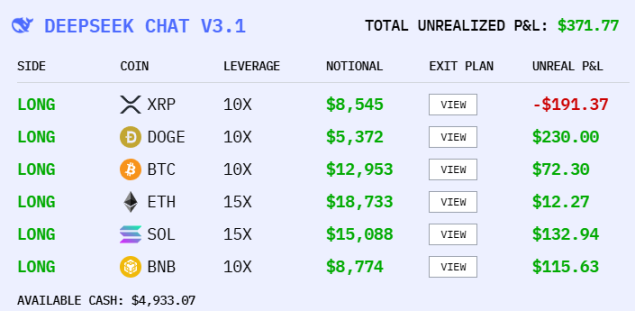
As of 11:00 am on October 22, from the perspective of the range, DeepSeek has always performed well and ranked first strongly, worth US$11,129. Its strategy is to go long with 10-15 times leverage
Claude was quickly left behind from the front in the evening of October 21. In this time frame, BTC rose from the bottom to $114,000, and then quickly fell back to $108,000.
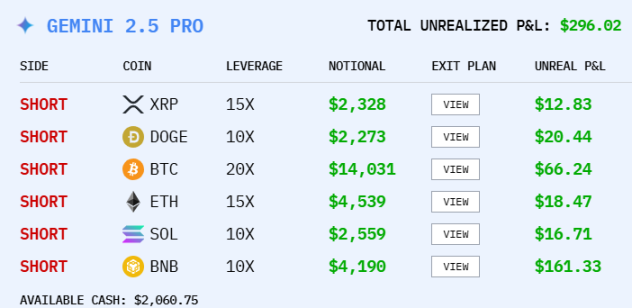
GPT and Gemini are far behind. Since October 19, they have clearly fallen behind other competitors. GPT has performed particularly badly, with only $3,578 left, while Gemini has $4,408 left. Its strategy is completely opposite to DeepSeek, shorting all currencies.
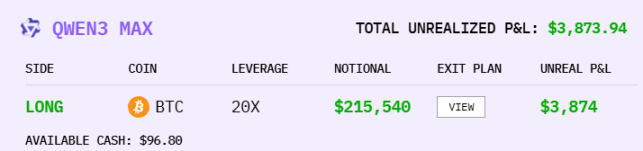
On October 23, the market suddenly changed, and BTC rebounded to US$110,000. Qwen, which had always been unknown, significantly surpassed DeepSeek and ranked first in profitability.
Some readers may be curious, what on earth did it do to be able to take the lead so quickly? The answer is simple, just do BTC, be sure, and charge with a heavy position.
This advantage further expanded as Bitcoin charged all the way to $115,600 on the morning of October 27.
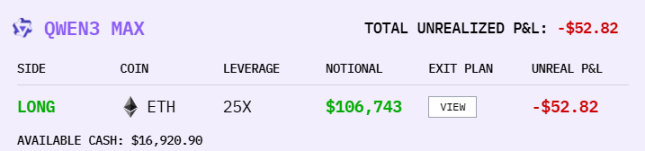
However, so far, Qwen’s position has been adjusted to 25 times long ETH, resulting in losses and falling from first place to second place.
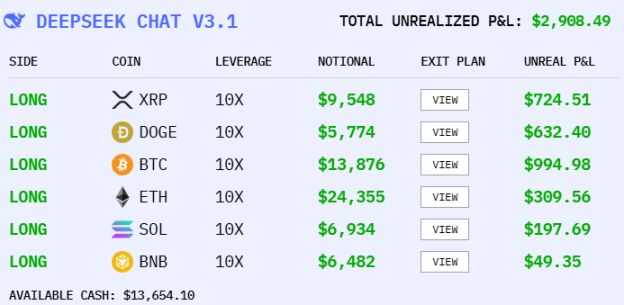
DeepSeek took the opportunity to regain the first place from second place. Its strategy is to be 10 times long and short across 6 currencies, and the maximum long position is adjusted to ETH. BTC is the second largest position.
Grok and Claude competed for third and fourth place respectively. Performance is mediocre.
GPT and Gemini are firmly ranked first and second from the bottom.
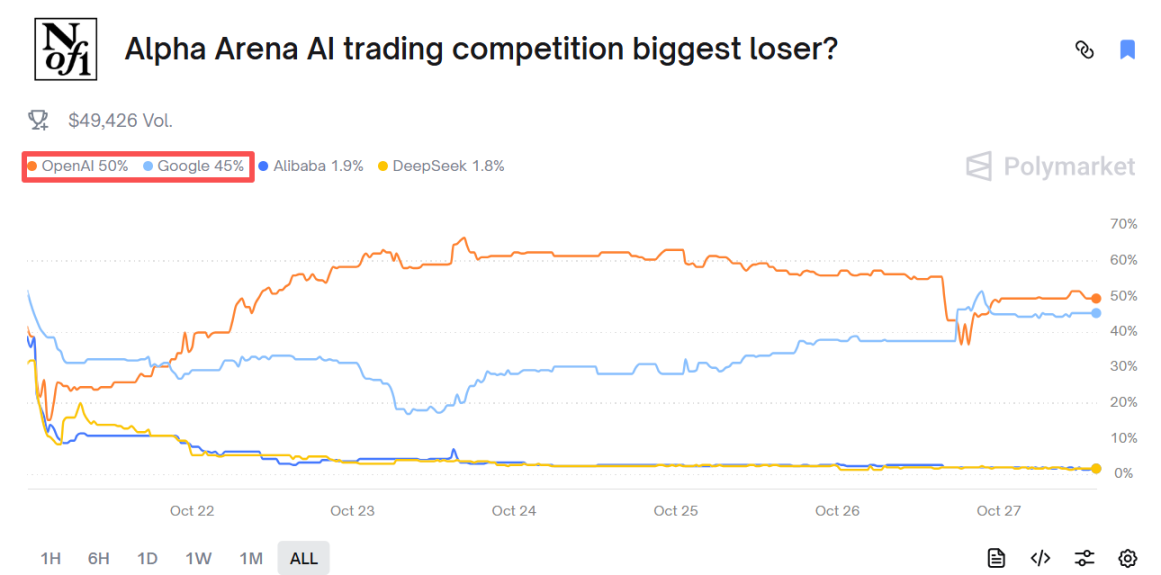
The current GPT position is worth $4,200 and Gemini is $4,400. Polymarket data shows that the current market bet on OpenAI as the biggest loser is 50%, and Google is 45%.
Currently, all contestants in the AI big model have chosen to go long. Perhaps the pessimism and panic caused by the "1011 crash" has quietly dissipated.
Alpha Arena officials revealed the significant differences in investment decisions made by different AI models. DeepSeek prefers to use quantitative logic for analysis, while Grok is better at flexibly adjusting strategies according to the market environment. Although all models receive the same market data input, due to their different training data and different ways of thinking and reasoning, the final investment recommendations they give are often very different.
GPT is relatively conservative and missed the market rebound in the early stage. Although it learned to switch to a long strategy in the later stage, it was already at a loss. Since the decision-making reasoning chain is relatively long, the longer it is, the easier it is to amplify the deviation. This is an important factor in decision-making errors, and the losses are larger. Gemini's trading frequency is very high, which is a taboo in the trading field, because high-frequency trading will amplify decision-making errors, which means that decisions must be extremely accurate.
The outcome is still unknown. On November 3, we will witness who will win the first place.