Etherscan surprise charges! Accidentally exposed the data dependence contradiction of the Ethereum ecosystem
Etherscan suddenly announced during Devcon that some APIs would no longer be free, causing dissatisfaction among developers. This controversy not only exposed the commercialization difficulties of blockchain data infrastructure, but also triggered in-depth discussions about decentralized data access.
(Preliminary summary: Fed releases doves) The probability of interest rate cut in December exceeds 80%, Bitcoin soared to US$89,000, Ethereum reached US$2,900, and US stocks rose together)
(Background supplement: BitMine added nearly 70,000 Ethereum, and the account floating loss expanded to US$4.25 billion! Tom Lee: It is very cost-effective to buy the bottom now )
On November 23, Lefteris Karapetsas, founder of the open source portfolio tracker rotki, tweeted about Etherscan. He said that Etherscan suddenly stated during Devcon that it would no longer provide free APIs for Avalache C-Chain, Base, BNB Chain, and OP Mainnet block explorers.
Although he can understand that providing free services is indeed stressful, but can he give a little advance notice or at least not choose it during such a large-scale event, when everyone is out of town for a "surprise attack" and there is no time to respond at all.
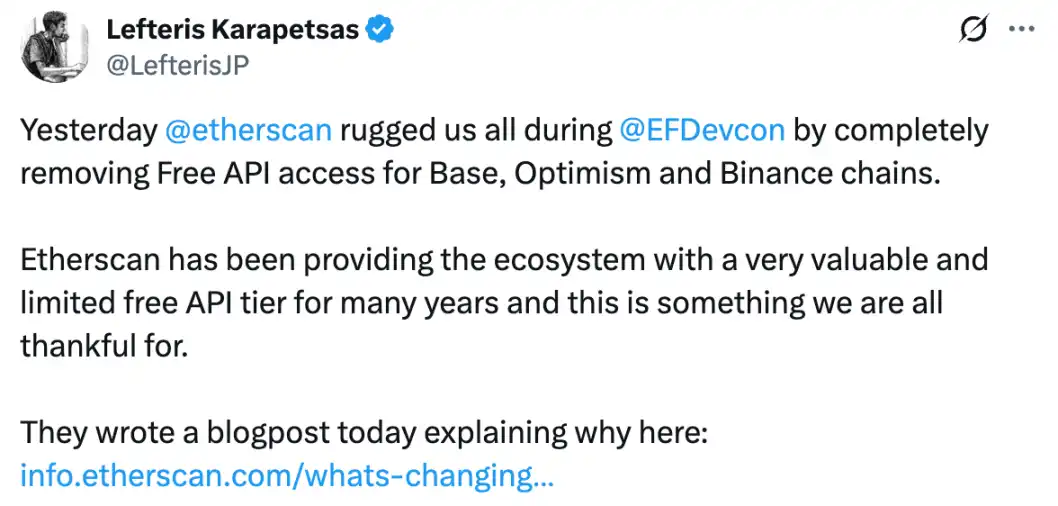
According to Etherscan's announcement, as the performance of the chain gradually improves, the amount of data has also increased significantly, which has also caused the cost to rise a lot. In this case, they can no longer afford all free APIs, and have no choice but to set some originally free APIs into paid versions.
Obviously, the APIs for specific chains cannot continue to be free. There is a high probability that they have not received enough funds or resource support.
Finally, this guy is still a little confused. Leaving aside Avalache, don’t Base, OP Mainnet and BNB Chain have the money to support such an important service?
However, opposition soon followed, and the first to bear the brunt was Jack, the founder of Routescan who also runs the Avalanche block browser Snowtrace. Jack provided some data that may only be known in the industry:
· Etherscan charges between 1.5 million and 2 million US dollars per year to supported chains, although some of them are only about 300,000 US dollars, but only provides very basic data;
· For those chains that have paid, Etherscan only provides 5 RPS (requests per second) for free. API, if you want more, the monthly subscription fee can be up to $899;
· Last month, the number of unique visitors to each Etherscan chain browser was: OP Mainnet, 102,000, BNB Chain, 2.5 million, Base, 1 million, HyperEVM, 30,000, Avalanche, 16,000. Etherscan itself has 4 million.
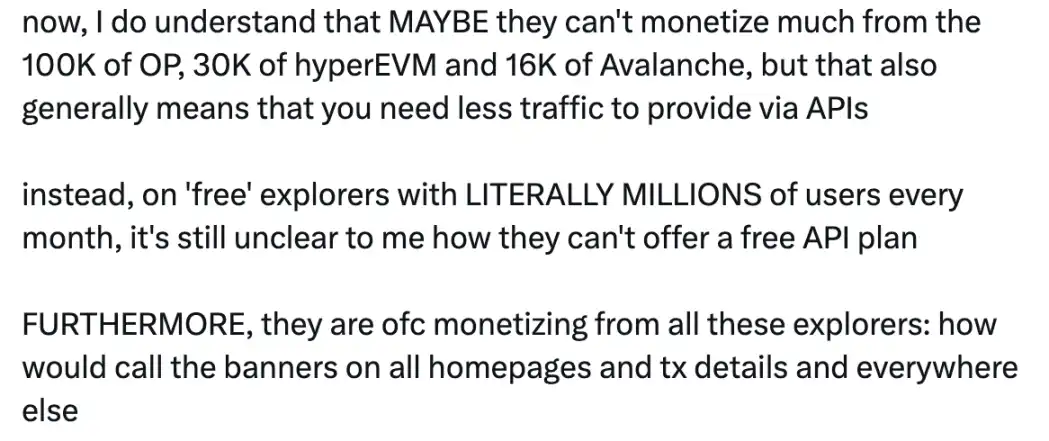
The implication of the CEO is: for a small number of APIs The charges are indeed due to financial constraints, but it’s not because we don’t think we make enough money. Some chains don’t pay and we have been free for a while. We have done our best, so please stop arguing and call it a day.
There isn’t much to say in the discussion on this issue. It’s just that some people think Etherscan is greedy, and some people think its business practices are understandable. But other discussions derived from this incident are very interesting.
Call for data openness organizations
First of all, it was through this incident that I learned that there is an ecosystem alliance VERA that promotes convenient, unified and open access to EVM smart contract source code, and the Open Labels Initiative, a standardized framework and data model organization that promotes EVM address labels. What these two organizations want to do is essentially the same, which is to support the accessibility of blockchain data, especially verification.
The Open Labels Initiative retweeted Lefteris Karapetsas’s tweet and said that in the past year they have been preventing over-reliance on centralized on-chain data providers from happening, and they believe that such important infrastructure should not be monopolized but should be built together.
Sourcefify.eth, which verifies Ethereum contract code, Ethereum data visualization platform growthepie, open source block explorer Blockscout, and the aforementioned Routescan are all contributing to the readability and accessibility of Ethereum data.
According to Reserve Protocol DeFi engineer Akshat Mittal, Etherscan was not involved in these matters. Is it for commercial gain? No one knows this, but even so it’s understandable. There will always be some people in the Ethereum ecosystem who adhere to the open source culture and reject excessive commercialization. Regardless of whether they are good or bad, this is the diversity of the ecosystem. For-profit organizations can ensure service quality, and open source products will also be useful.
Comparison of data query mechanisms between IC and Ethereum
In addition, zCloak Network founder 0xFrancis, who has been praising IC recently, once again made a comparison between IC and Ethereum.
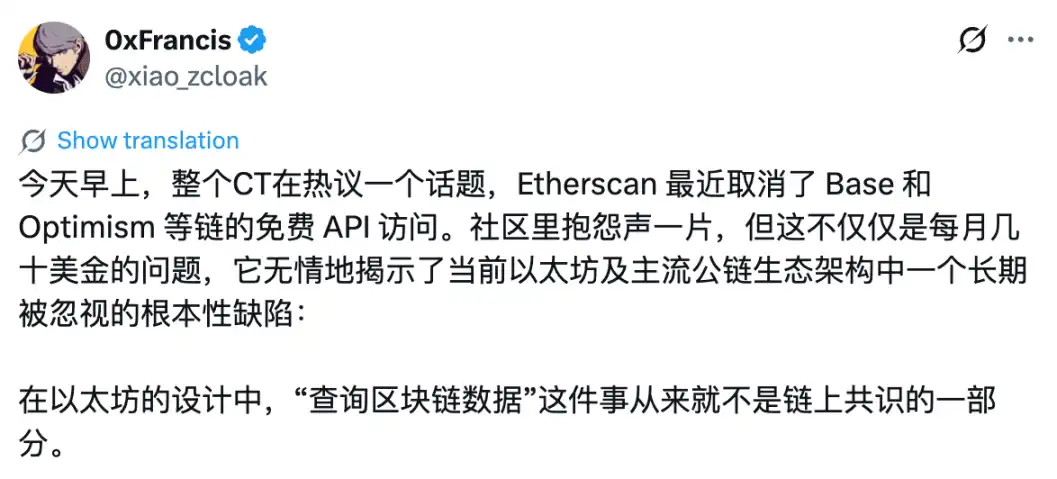
0xFrancis said that Ethereum does not include "querying block data" as part of the consensus, and developing DApps must rely on third-party RPC services. If RPC The nodes collectively lose contact. Although the chain will continue to operate, it will become "unreadable".
Going deeper, if a centralized RPC node or a website like Etherscan provides false data, it can easily deceive others. IC regards the query itself as part of the agreement. When someone initiates a query request, the request will be uniformly executed through the ICP node network and cryptographically authenticated data will be returned to ensure the accuracy of the data.
0xFrancis’s words are not unreasonable, and this can be used as a typical case of IC being too ahead of its time. The debate surrounding Etherscan’s fees is also a typical debate about centralization and decentralization. However, is it precisely because of some imperfections and components that need to be commercialized that Ethereum has led to the prosperity of the ecosystem?