The father of DeFi is back! Andre Cronje's new project Flying Tulip aims to raise $1 billion
Andre Cronje, known as the father of DeFi, returns with a new project Flying Tulip. The innovative token public offering mechanism allows investors to withdraw their principal at any time.
(Previous summary: Damn thief! DeFi godfather AC is choking: there is a billion-dollar project "stealing Sonic code" for personal gain)
(Background supplement: DeFi OG's new project inventory: Curve founder builds BTC pool, Andre Cronje wants to build a universal exchange)
Contents of this article
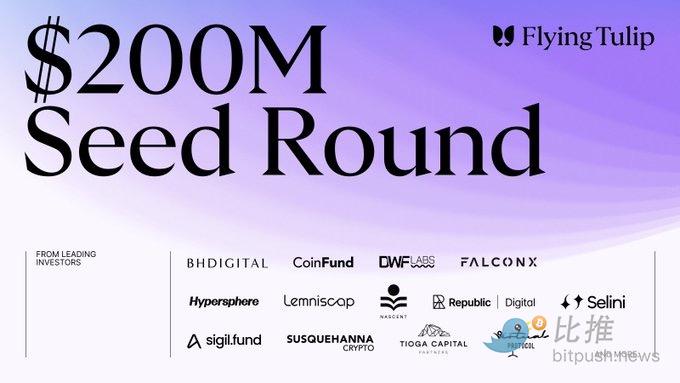
When everyone thought Andre Cronje When he faded out of the encryption circle, the legendary figure known as the "Father of DeFi" returned. This time he brought a brand new project - Flying Tulip, which recently announced the completion of US$200 million in financing and plans to launch a public sale of tokens.
What's even more special is that this public offering comes with an unprecedented mechanism: users can destroy tokens at any time and get their principal back. This means that participants have "bottom-line protection" for their downside risks, while there is still no upper limit for upside returns.
Who is Andre Cronje?
If you experienced the DeFi summer in 2020, you must have heard his name.

Andre Cronje is the founder of Yearn Finance (YFI) - a company that started DeFi with just programming Legendary developer of craze. YFI was once known as the "fairest token" because he did not reserve any share for himself at the time.
However, after experiencing several project explosions, community disputes and safety incidents, Cronje faded from the public eye in 2022. To this day, he "comes out again" with Flying Tulip.
What is Flying Tulip?
The editor’s interpretation: "Flying Tulip" literally means "flying tulip". Tulips are the most famous bubble symbol in financial history (the "Tulip Mania" of the 17th century was the earliest speculative bubble).
Cronje named the project Flying Tulip, which is a bit self-deprecating and a bit of a declaration: the encryption world may be like tulips, but this time, he wants to make it really "fly". In other words, Flying Tulip wants to make what used to represent "bubbles" more stable, more real, and more viable through on-chain mechanisms.
Judging from official documents, Flying Tulip hopes to build a full-chain financial platform that puts many functions familiar to crypto users—stablecoins, lending, spot trading, derivatives, options, and insurance—into one system.
To put it simply, it wants to be a "one-stop DeFi platform" that allows users to:
- Deposit currency to earn income;
- Borrow currency for leverage;
- Go long and short;
- Even hedge risks through on-chain insurance.
These are all completed in a unified account system, and there is no need to switch frequently between different platforms.
A “refundable” token public offering
The most eye-catching thing this time is Flying Tulip’s “Onchain Redemption Right”.

Traditionally, once users participate in the public sale of tokens, their money is locked regardless of the rise or fall of the currency price. However, Flying Tulip provides a "programmed redemption" mechanism: all participants can destroy the $FT tokens in their hands at any time and get back the principal they invested (such as ETH).
The system will automatically return funds from a separate on-chain reserve pool.
This design is a bit like an on-chain insurance mechanism, which not only ensures that investors will not "lose money", but also retains room for growth.
However, it should be noted that the official also reminds that this is not a "guaranteed return of capital" or "deposit insurance" - the size of the reserve pool is limited, and whether the redemption right can be executed depends on whether the funds in the pool are sufficient.
Funds are not locked: use returns to feed growth
Cronje mentioned in the roadshow materials presented to investors that this design seems to make it impossible to use funds, but in fact Flying Tulip plans to invest this capital in on-chain revenue strategies, such as mainstream DeFi protocols such as Aave, Ethena, and Spark.
They are targeting an annualized return of approximately 4%.
Based on the planned financing limit of US$1 billion, it will generate approximately US$40 million in interest income per year.
- This proceeds will be used for:
- Payment protocol incentives;
- Repurchase of $FT tokens;
- Support ecological growth and market promotion.
Cronje described this in investor materials: "We use cyclical returns to drive growth and incentives, use permanent put rights to protect investors from the downside, while retaining the unlimited upside potential of the token - this forms a self-reinforcing growth flywheel."
The team has no reserved shares
Another highlight is that the Flying Tulip team does not have any initial token distribution.
All their income comes from the real income of the project. They use these income to buy back $FT tokens in the market and release them according to the public plan.
In other words, the team can only get rewards when the protocol really makes money and users really use it.
This puts the team in the same boat as the investors - the more popular the project, the more they make.
Luxurious capital lineup, targeting US$1 billion in financing
Flying Tulip has completed US$200 million in private financing, with investors including:
- Brevan Howard Digital
- CoinFund
- DWF Labs
- FalconX
- Hypersphere
- Nascent
- Republic Digital
- Susquehanna Crypto et al.
Next, they will launch public offerings on multiple chains at the same time, with a target total financing of up to US$1 billion.
Summary
The emergence of Flying Tulip is reminiscent of the era of 2020 when "code changed finance".
The difference is that this time Andre Cronje wants to do more than just innovate products, but to make DeFi more credible and sustainable. Today, after DeFi has experienced a bear market reshuffle and trust has collapsed, Cronje's return may not only be the comeback of a developer, but also a signal: a new DeFi cycle is expected to be rekindled.