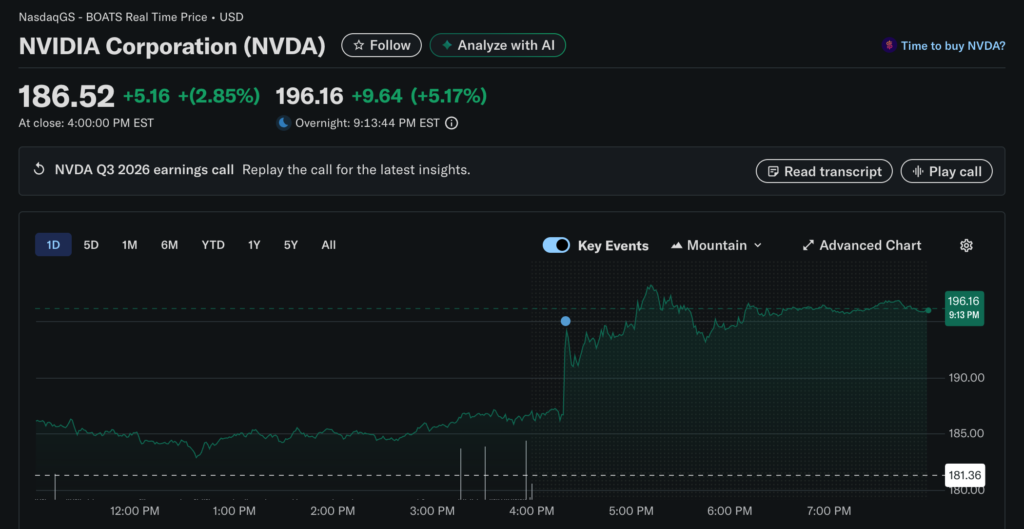
Huida's Q3 earnings report shattered the AI bubble theory. Huang Renxun: Blackwell demand is so good that Nvidia rose 5% after the market.
NVIDIA, a major chip manufacturer, released its latest Q3 financial report this morning, Taiwan time. NVIDIA's third-quarter revenue increased by 62% year-on-year, exceeding analysts' expectations. Huang Renxun is optimistic about the strong demand for Blackwell chips, and the stock price rose after the market.
(Preliminary summary: Silicon Valley godfather Peter Thiel cleared out Huida's "AI early bubble", don't let Nvidia focus on three technology stocks)
(Background supplement: Nvidia Huida's earnings day may be embarrassing? Analyst: Even if the performance is strong, the market will be "nervous")
Contents of this article
The global AI chip leader NVIDIA (Huida) in 19 After the market closed, Japanese and American stocks responded to external concerns about the AI bubble with a brilliant financial report. The company's third-quarter financial results showed that Q3 revenue was US$57 billion, an annual increase of 62%, and earnings per share were US$1.30, both exceeding analysts' expectations.
Financial report highlights: both revenue and profit exceeded standards
The highlight of this quarter is the substantial growth in revenue and profit. Revenue of US$57 billion crossed Wall Street's original estimate of US$54.9 billion; non-GAAP gross profit margin remained at 75%, reflecting that the company's pricing power in the high-end GPU market remains solid.
Huida also gave a fourth-quarter outlook of $65 billion (±2%), above the consensus forecast of $61.6 billion. According to a company press release, management stressed that order-taking visibility covers the coming year.
Data center drives growth, Blackwell contributes order visibility
The core driving performance is the data center department; it contributed US$51.2 billion in a single quarter, an annual increase of 66%, accounting for nearly 90% of total revenue.
Huang Renxun described it at the forum:
The demand is so good that it is overwhelming. Our customers are rushing to bring these systems online because to them, this is contemporary electricity.
Blackwell and Blackwell Ultra chips have been fully booked for the next 12 months, indicating that the production line replacement is smooth and there is no inventory pressure. So far, Huida has been able to maintain high gross margins even if the supply chain is tight, which also shows that customers are more concerned about whether they can get the chips, rather than the price.
Cloud major customer expands cooperation with 10 GW
According to TechCrunch analysis, Blackwell architecture helps Huida maintain a near-monopoly position in the cloud infrastructure market. The phenomenon of "all cloud GPUs are sold out" shows that customers are not hoarding goods, but directly investing in inference and training services.
Very large-scale cloud players such as Microsoft, Amazon, Google, and Meta also continue to increase capital expenditures and regard Huida GPU as the core asset of AI services.
The moat deepens and the market focuses on energy bottlenecks
On the other hand, the U.S. Department of Energy recently announced that a new generation of AI supercomputers will use 100,000 Blackwell GPUs, further consolidating Huida’s importance in the fields of national security and scientific research. Although Huida’s robotics and automotive division currently only contributes US$592 million, its 32% annual growth rate reveals room for future growth.
Overall, Huida once again demonstrated its ability to "beat expectations and raise financial forecasts." Short-term stock prices may be affected by profit-taking or macro sentiment, but the financial report shows that AI infrastructure investment is still in the expansion stage (Huida's stock price rose by more than 5% after the bell).
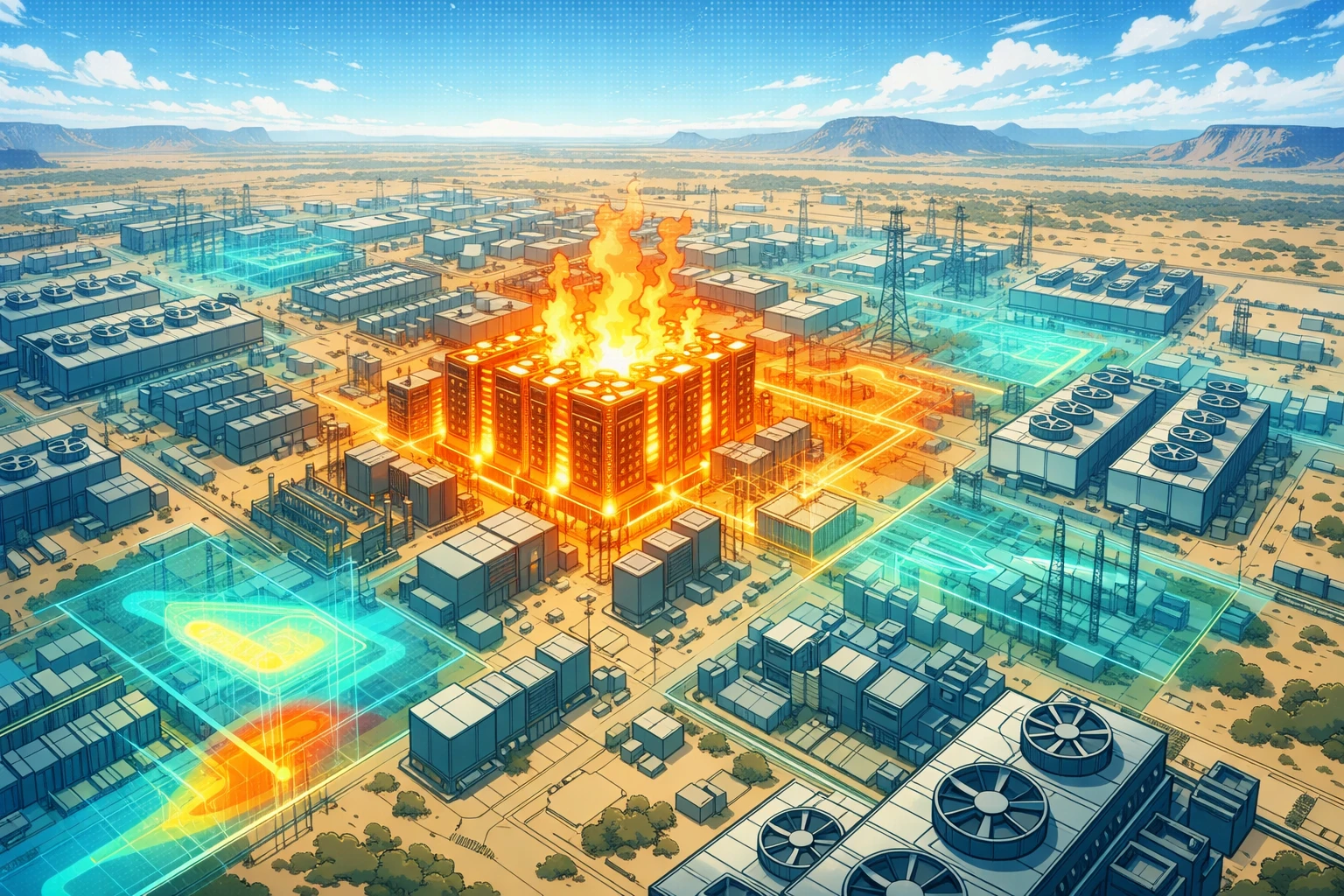
With cloud giants continuing to increase their investment, Blackwell chips being in short supply, and deepening cooperation with ecological partners such as OpenAI, Huida’s current industry positioning is like a sea of stone. The variable in the future may not be whether the company can continue to grow, but whether the global energy and supply chain can support the rapidly expanding AI era.