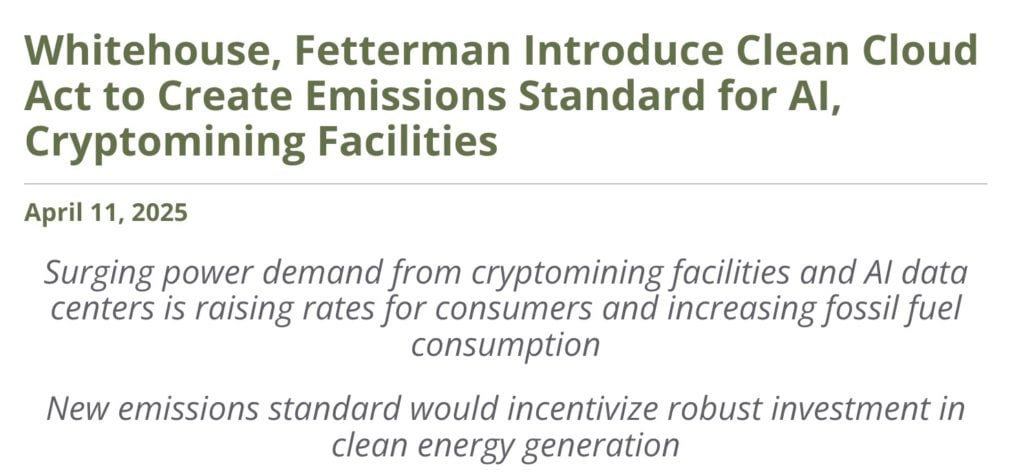
The Democratic Party proposed the "Clean Cloud Act" to require U.S. Bitcoin mining companies and AI computing centers to embrace green energy: achieve zero carbon emissions by 2035
The U.S. Senate proposed the Clean Cloud Act of 2025, which requires cryptocurrency mines and AI data centers to phase out fossil fuels or face fines, aiming to achieve zero emissions by 2035.
(Preliminary news: Breaking news》Bitcoin mining company Hut 8 cooperates with Trump's son to jointly establish a new mining company "American Bitcoin")
(Background supplement: A look at the progress of the U.S. State Crypto Reserve Act)
Contents of this article
The U.S. Senate recently proposed a draft called the "Clean Cloud Act of 2025" (Clean Cloud Act of 2025), sponsored by Democratic Senators Sheldon Whitehouse and John Fetterman co-presented.
The bill aims to strictly limit the carbon emissions of cryptocurrency mining companies and artificial intelligence (AI) data centers, and sets a clear timetable with the ultimate goal of achieving zero emissions by 2035, and imposes fines on any facilities that still use non-renewable energy.
Core mechanism of the bill: regional emission caps and annual reductions
According to the content of the draft, the bill will amend the current "Clean Air Act" (Clean Air Act). Going forward, all data centers with more than 100 kilowatts (kW) of energy capacity, including cryptocurrency mining farms and AI computing centers, will have to comply with region-specific emission caps.
The standards for these caps will be based on the characteristics of different power regions as defined in the National Transmission Requirements Study published by the U.S. Department of Energy. This means that facilities in different regions will face different emission reduction pressures, taking into account differences in energy structures and power grids in each region.
The bill stipulates that specific emission caps for each region will be set before the end of 2025. Thereafter, the cap will be reduced by 11% each year until reaching zero emissions in 2035. For companies that fail to meet the emission cap, inflation-adjusted fines will be imposed based on their excess emissions.
It is worth noting that the draft also explicitly prohibits relevant companies from passing on these fine costs to their customers, ensuring that the companies themselves assume environmental responsibilities.
Strict reporting obligations and responsibilities
In addition to requiring relevant facilities to submit detailed annual reports, the report must include key data such as their total power consumption and power sources (ratio of renewable energy and fossil fuels).
A noteworthy detail is that the bill places the responsibility for paying fines on the "lessee of the leased facility" rather than the facility owner. This means that even individuals or companies that rent server space for mining or AI computing may be included in reporting requirements and potential fines, expanding the scope of the bill.
Looking on the bright side, if the bill is passed, it will prompt cloud service providers and data center operators to more actively seek green power solutions to attract customers who are sensitive to environmental regulations. But it may pose a greater challenge for smaller players, who may lack the resources of larger companies to undertake the energy transition or deal with complex regulatory compliance requirements.
The encryption mining industry has adopted a large amount of renewable energy
According to statistics at the end of last year, more than 50% of the energy used by the global Bitcoin mining network actually comes from renewable energy sources such as water, wind, and solar energy. Regions with abundant and cheap green energy, such as Iceland and Quebec, Canada, have become popular options for miners.
If the "Clean Cloud Act" is indeed passed in the future, mining companies and AI computing centers will undoubtedly accelerate the pace of embracing renewable energy, and may eliminate those companies that are unable or unwilling to adapt.
Overall, the draft is a quite aggressive emission reduction schedule, forcing relevant companies to plan energy transition strategies as early as possible. However, in the context of Trump’s administration, he has repeatedly stated that global warming has nothing to do with carbon emissions. This bill is bound to face resistance from the Republicans in Congress (the Republicans may argue that overly stringent environmental regulations will stifle innovation and weaken the United States’ competitiveness in the two frontier fields of cryptocurrency and AI). Whether it will be passed in the future is still uncertain.